Banks Down. Digital Dollars Next?
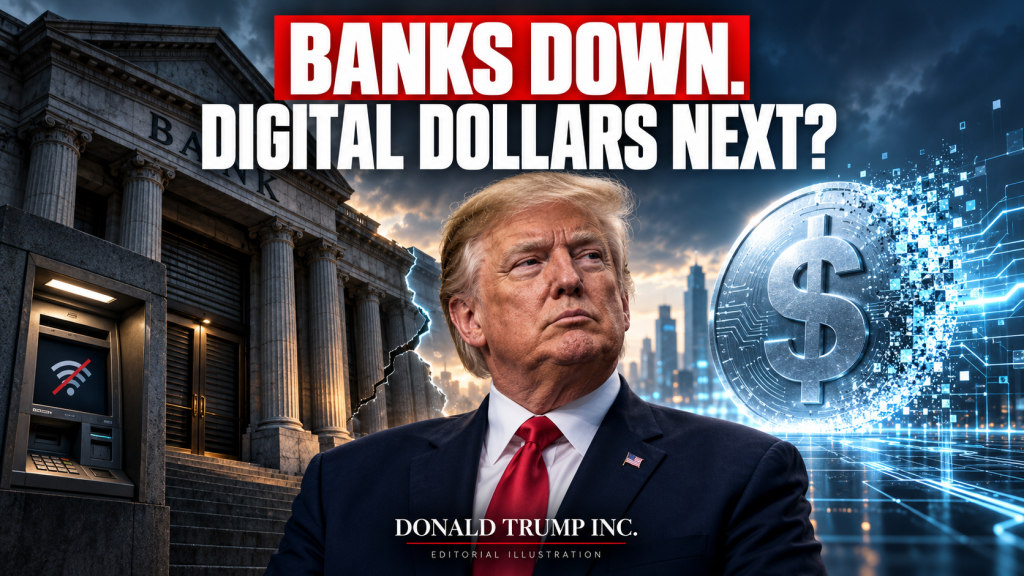
Cyberattack warnings, digital-money policy and the evidence behind the financial-reset theory.
Picture a payment outage that lasts long enough to interrupt payroll, supplier payments and access to savings. Then imagine a replacement wallet being offered as the fastest way to get money moving again. Would Americans freely choose it, or feel they had no practical alternative?
That is the serious question behind the theory that a financial cyber crisis could accelerate digital-currency adoption. The sources reviewed for this article establish a real cyber threat, years of attack-response exercises and substantial concerns about financial control. They do not establish a coordinated plan to attack banks or make Americans accept digital currency to recover their balances.
Where the theory comes from
This argument predates the last few months. In February 2021, Whitney Webb and Johnny Vedmore argued in Unlimited Hangout that a catastrophic cyber incident could facilitate a financial reset and greater control through public-private digital systems. Their article connected Cyber Polygon, elite economic-policy networks and digital-finance development. It also advanced the much stronger allegation of a controlled banking collapse. [4]
Some of the underlying connections are verifiable. Cyber Polygon’s organizer, BI.ZONE, described its July 2021 technical exercise as training to respond to a targeted supply-chain attack. BI.ZONE was part of Sber’s ecosystem, and the event had support from the World Economic Forum’s cybersecurity center and INTERPOL. [2]
The same event announced a panel featuring the Bank of Russia, Mastercard and Visa on digital currencies and financial resilience. A World Economic Forum official was scheduled to moderate. Cybersecurity and the future of money really were on the same agenda. [3]
That overlap justifies examining the institutions, incentives and proposed policies. It does not identify an agreement to cause a real attack. Exercises can reveal the disruptions planners fear and the responses they prefer; establishing criminal preparation would require additional evidence connecting actors, intent and operations.
The trillion-dollar risk is documented
Lloyd’s published a hypothetical payments-system cyberattack scenario in October 2023 that put potential global economic losses at $3.5 trillion over five years, including $1.1 trillion in the United States. The estimate concerns lost economic activity following disruption, rather than $3.5 trillion disappearing from bank accounts. It is a scenario, not an attack forecast. [1]
The commercial significance is straightforward: a prolonged payment failure can hurt companies that were never hacked themselves. If customers cannot pay, suppliers cannot collect and payroll cannot clear, disruption can spread beyond the original victim. That possibility warrants scrutiny without a claim that someone has scheduled the crisis.
A credible criticism: money can become a control mechanism
The Cato Institute supplies a substantive policy argument worth taking seriously. In their 2023 analysis, Nicholas Anthony and Norbert Michel argued that a central bank digital currency could expand financial surveillance, reduce financial freedom and destabilize banking. This is an argument about institutional power and system design. It does not validate an allegation that authorities intend to manufacture a cyberattack. [5]
There is also a primary-source statement behind a frequently circulated warning. At an October 2020 IMF event, then-BIS general manager Agustín Carstens described a CBDC as giving the central bank “absolute control on the rules and regulations” governing that form of central-bank money, together with technology to enforce them. The IMF’s own account records the statement. [6]
Those words deserve examination. They establish that enforceable rules were part of the discussion. They do not establish an adopted U.S. policy to restrict purchases by political belief, location or social score.
Design remains decisive. The Federal Reserve’s 2022 discussion paper proposed that any potential U.S. CBDC protect privacy and operate through intermediaries, while also verifying identity. It acknowledged that a CBDC could intensify bank runs if people fled commercial-bank deposits during a panic. The paper explored possibilities; it did not authorize issuance. [7]
Trump’s actual direction changes the story
A Federal Reserve digital dollar and a private dollar-backed stablecoin are different financial claims. A retail CBDC would be a direct Federal Reserve liability available to the public. A stablecoin is a token issued by another entity and designed to maintain a reference value, such as one dollar. Ordinary dollar bank balances are already largely digital. [7]
Trump’s January 23, 2025 executive order opposed a CBDC while supporting lawful dollar-backed stablecoins. That makes a prediction of an imminent Trump-launched Federal Reserve currency inconsistent with his published policy unless that policy changes. [8]
There is now a statutory barrier as well. Section 1101 of the 21st Century ROAD to Housing Act, which became law July 11, 2026 without Trump’s signature, prohibits the Fed from creating or issuing a public CBDC or a substantially similar asset, directly or through intermediaries. It includes an exception for a currency meeting stringent openness and cash-like privacy conditions. The restriction sunsets December 31, 2030; the text also says it does not authorize issuance without an Act of Congress. [9]
Private stablecoins have a different policy trajectory. Trump signed the GENIUS Act in July 2025, establishing a regulatory framework for payment stablecoins. The White House promotes them as a way to modernize payments and support the dollar’s international position. A cyber crisis would not be needed to start that agenda: it is already public. [10]
That distinction does not settle the control question. The GENIUS framework requires regulated issuers to maintain transaction-blocking capabilities and comply with lawful orders. It also requires reserve backing and makes clear that payment stablecoins are not federally insured deposits or government-guaranteed money. These provisions create concrete questions about access, enforcement and consumer protection. They do not authorize arbitrary political punishment or compulsory conversion of everyone’s bank balance. [11]
The strongest evidence for crisis-driven adoption
An August 2026 New York Fed staff paper provides a useful test of the narrower theory. Pablo Azar, Maryam Farboodi and Nish Sinha examined wallet activity around nine episodes of banking or monetary stress across eight countries during 2021–2025. They found increased dollar-stablecoin inflows and receipt activity among wallets associated with crisis countries. [12]
The paper reports preliminary research and does not necessarily represent Federal Reserve policy. Its geographic classifications rely on signals in Ethereum Name Service registrations, rather than a representative survey of all bank customers. The episodes do not test a U.S. cyberattack or forced conversion. Even with those limits, the findings support a credible mechanism: financial stress can make alternative payment channels more attractive. [12]
It is plausible that a major American outage could increase demand for alternatives or strengthen the political case for upgrading payment infrastructure. Whether stablecoins would help depends on what failed and which systems remained available. Consumer demand, official encouragement and compulsory conversion are three different propositions.
A replacement system can fail, too
The IMF’s 2024 work on CBDC cyber resilience warns that issuing one creates a complex ecosystem that can amplify existing risks and introduce new ones. A new label for money does not make its supporting systems invulnerable. [13]
FedNow also needs to be kept out of the wrong category. It is an instant-payment service for participating banks and credit unions. The Fed states that it is neither a digital currency nor a step toward eliminating cash. Its existence does not establish a hidden CBDC launch. [14]
What would turn suspicion into a reportable finding?
The evidence to watch is specific: an emergency order conditioning access to restored funds on a new wallet; legislation compelling conversion; procurement documents linking disaster recovery to a named currency; verified plans to withdraw cash access; or authenticated communications establishing coordination of an attack. None of the reviewed sources establishes such a plan.
For DT Inc., the transaction matters. Which issuers and technology vendors would receive emergency contracts? Who would earn fees or reserve income? Could customers redeem at face value and retain practical alternatives? Who could freeze funds, under what authority, and with what appeal process? Who would pay if the replacement failed?
A cyber crisis could accelerate a change in how Americans move money. That possibility deserves investigation now. Any proposed rescue should disclose its terms before people are asked to depend on it.
Sources and further reading
[1] Lloyd’s, October 18, 2023 — Systemic-risk scenario; hypothetical economic losses over five years.
[2] Cyber Polygon organizer, February 3, 2021 — Primary description of the exercise, organizer and supporters.
[3] Cyber Polygon organizer, July 6, 2021 — Primary announcement of the digital-currency panel.
[4] Whitney Webb and Johnny Vedmore, February 5, 2021 — Original argument examined; its allegations are not independent confirmation.
[5] Nicholas Anthony and Norbert Michel, Cato Institute, April 4, 2023 — Policy analysis opposing CBDCs; a credible institutional critique with an explicit position.
[6] IMF Media Center, October 20, 2020 — Primary account of the Carstens remarks; includes a link to the full discussion.
[7] Federal Reserve, January 2022 — Discussion paper on CBDC definitions, privacy, intermediaries and bank-run risks.
[8] White House, January 23, 2025 — Executive order: opposition to CBDCs and support for dollar-backed stablecoins.
[9] Public Law 119-101, July 11, 2026, section 1101 — Controlling statutory text: restriction, exception, sunset and congressional authorization.
[10] White House, July 18, 2025 — Administration’s description of the GENIUS Act and intended benefits.
[11] Public Law 119-27, July 18, 2025 — GENIUS Act, especially sections 4, 5(e) and 20. Enactment and implementation dates differ.
[12] Azar, Farboodi and Sinha, New York Fed Staff Report 1202, August 2026 — Preliminary research; authors’ views. Crisis adoption evidence does not establish cyberattack causation.
[13] IMF, August 27, 2024 — Cyber resilience of the CBDC ecosystem; operational risks and design implications.
[14] Federal Reserve FAQ, updated July 12, 2023 — FedNow’s function and its distinction from a CBDC.