70 MILLION ACCOUNTS—BUT THE $1,000 HAS A BIRTH-DATE CUTOFF

Creating an account is the opening move. Building a balance is the business test.
The White House announced October 7 that nearly 70 million Trump Accounts have been created, more than 60 million through automatic enrollment. Parents or guardians still need to claim an account to manage it and family contributions.
Who gets the federal $1,000?
The IRS sets a specific eligibility window: the one-time federal seed contribution is for children born January 1, 2025, through December 31, 2028, who are U.S. citizens with valid Social Security numbers. Older children can have accounts, but they do not qualify for this federal seed payment.
That distinction matters. A child born in 2024 can have an account without receiving the government’s $1,000. An eligible child born in 2025 can qualify even though that child is no longer a newborn. The cutoff is the birth date.
Older children may receive money from families, employers or eligible philanthropic programs. Being outside the federal birth cohort does not mean an account must remain empty.
Follow the deposits
The administration reports more than $4.5 billion deposited since launch: $1.3 billion in federal seed contributions, more than $600 million from family and friends, and $2.6 billion in philanthropic gifts. Those are administration-reported totals, not an independent audit by Trump Inc.
The deposit total establishes that money is moving. It does not show how many accounts have a positive balance, how many parents have claimed them, or how the money is distributed across households. The October 7 release does not provide those measures.
DT Inc. analysis: distribution first, recurring capital next
Viewed through a business lens, automatic enrollment creates a distribution network at enormous scale. The next challenge is converting that reach into active participation, sustained contributions and useful household assets.
Families with spare income can make repeated deposits. Families struggling to cover rent, food and transportation may have little capacity to contribute. A shared account structure can widen access to investing while still producing very different balances. Whether outside contributions narrow that gap is a question for the data.
Family, friend and employer contributions are subject to a combined $5,000 annual limit; the employer portion can be up to $2,500, according to the White House summary. The federal seed and qualifying philanthropic contributions have separate treatment.
For financial firms, a nationwide network of childhood accounts could become a long-lived customer base. For the administration, the program attaches the president’s name to an investing relationship that can last for years. Those are potential commercial and political benefits; neither tells us how much wealth families will ultimately gain.
Where does the money go?
Treasury’s July launch announcement named an S&P 500 index ETF as the default investment and identified additional low-cost U.S. index options. That connects deposits to equity markets, where returns can rise or fall.
There is also a distinct donation route: Treasury announced it would accept approved publicly traded stock from eligible philanthropic contributors for children’s accounts. The program therefore should not be described as exclusively an index-fund pipeline. Donated individual stocks make diversification and concentration relevant questions, too.
These are investment accounts, not cash checks parents can spend today. They are tax-advantaged, rather than universally tax-free. Long-term projections depend on contributions, returns, expenses and applicable tax rules; growth is not guaranteed.
The numbers that would prove success
Claim rates: How many automatically enrolled accounts become actively managed by parents or guardians?
Funding rates: How many have a positive balance, and how many receive recurring contributions?
Distribution: What are the median balances by income group and age, and how much support reaches older children?
Costs and holdings: What fees do families actually pay, and how concentrated are accounts receiving donated stock?
Continuity: Will Congress authorize seed funding for children born after 2028?
The DT Inc. test: account created does not mean account funded—and account funded does not mean wealth built. The milestone is reach. The outcome to measure is durable household assets.
Trump Inc. is an independent publication. Reporting above is attributed to official sources; the business interpretation is our analysis.
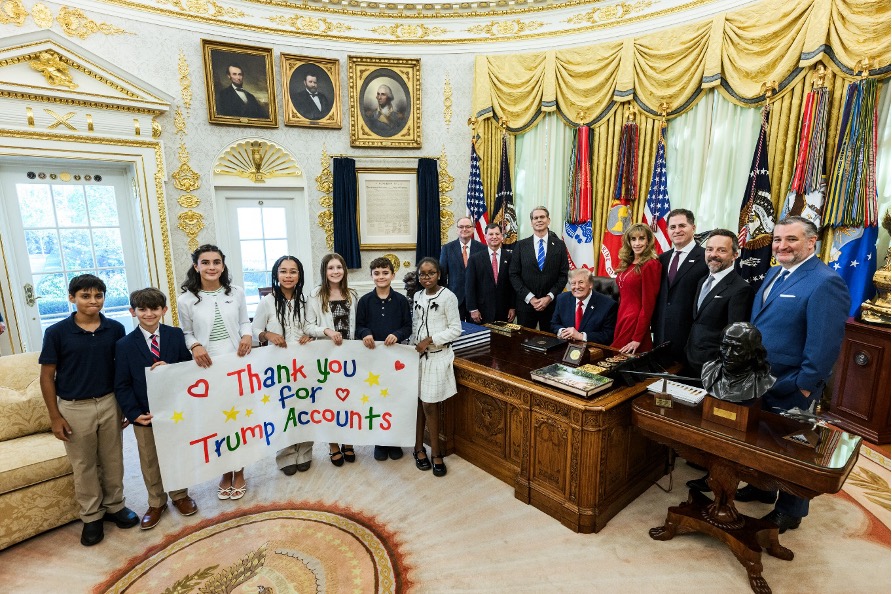
Event photograph: President Donald Trump with children and other participants at the October 7, 2026, Trump Accounts event. Official White House photograph; editorial cover design by Trump Inc.