Trump’s Bounties: Who Gets Paid?
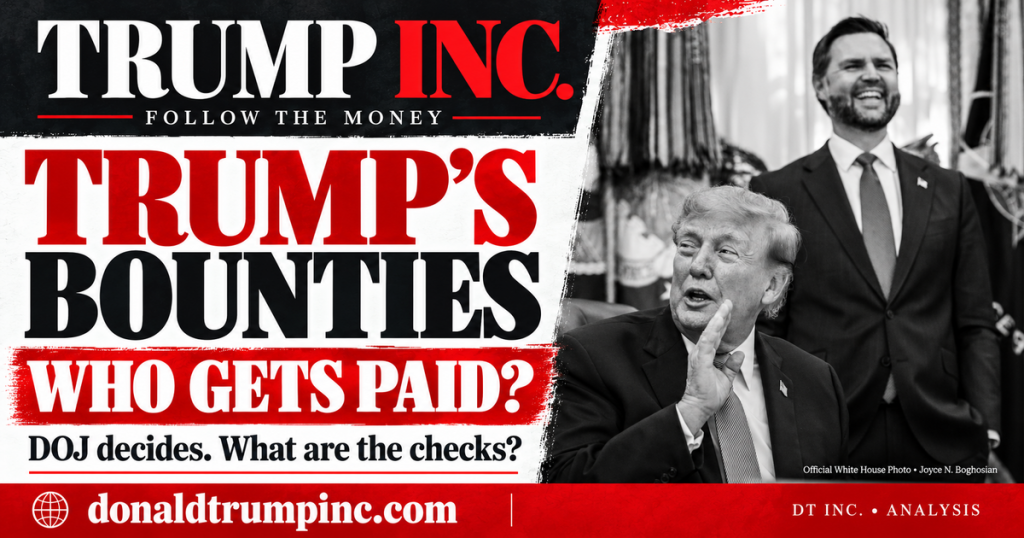
AI-assisted editorial graphic based on an official White House photograph by Joyce N. Boghosian, October 20, 2026. Independent Trump Inc. analysis; no White House endorsement implied.
DOJ decides who receives an award. Its rules say award decisions cannot be appealed or judicially reviewed.
DT Inc | Analysis | October 22, 2026
Washington wants the public to help catch fraud. Taxpayers should also be able to follow the decisions made in their name.
President Donald Trump and Vice President JD Vance announced the Fraud Whistleblower Incentive Program on October 20. The Justice Department says Treasury is committing $25 million to its implementation, with potential rewards of $10,000 to $30,000 for qualifying information that leads to criminal charges. [1], [2]
There is a reasonable idea here. Someone who sees suspicious billing, fabricated services or manipulated records may be able to give investigators evidence they would otherwise miss. Paying sooner could make coming forward more practical. But the public deserves to know how a tip becomes a case, how a reward gets approved, and who checks those decisions.
Start with what the rules actually say
This has moved beyond a proposal: DOJ has published program rules and directs people to a reporting portal. That establishes an announced program with a submission process, not a verified record of payments or recovered money. The published guidance describes an initial three-year pilot. [3], [4]
The payment trigger needs care. AP reported the White House’s description of tips leading to a conviction or significant federal enforcement action. DOJ’s written rules allow discretionary awards around the charging stage, before a case is finally resolved. Eligibility does not guarantee payment. A criminal charge is an allegation, not a finding of guilt. [4], [6]
That distinction should appear wherever the reward is promoted. People considering a report need the actual conditions, not just the biggest number in the announcement.
A tip needs evidence
DOJ requires voluntary, truthful and complete original information, along with cooperation. Its FAQ says staff review submissions under the direction of the National Fraud Enforcement Division’s assistant attorney general. Only the first of two identical submissions can qualify. Fraudulent submissions can lead to a permanent program ban and possible prosecution. [3], [4], [5]
Those are meaningful guardrails. The next questions concern how they work: What corroboration is required? How are originality and submission order verified in a disputed claim? How do reviewers distinguish a billing mistake from deliberate fraud? What prevents a personal grudge, viral accusation or political campaign from gaining more attention than stronger documentary evidence?
Investigators cannot publish every lead. They can explain their standards without exposing witnesses or compromising cases. The public should not have to confuse a popular allegation with a proven one.
What protects a whistleblower who gets exposed?
DOJ offers conditional confidentiality, with legal, policy and court-related exceptions. Anonymous submissions go through an attorney, and DOJ must verify a recipient’s identity before paying an award. [4], [5]
If retaliation follows, the program tells the whistleblower to report it to DOJ. The department may take enforcement action or deny a company credit for cooperating with investigators. These rules do not promise immediate protection, a restored job or compensation. They expressly create no new enforceable rights. [4]
That does not erase protections under other laws. For example, qualifying employees, contractors or agents facing workplace retaliation for lawful efforts to stop False Claims Act violations can seek relief in federal court, including reinstatement and double back pay. Coverage depends on the facts and the statute; submitting a WHIP tip alone does not establish it. [7]
The practical question deserves a direct answer before anyone takes that risk: If my identity gets out and I am threatened or fired, who will help me, how quickly, and through which enforceable protection?
Who decides who gets paid?
AP reported that Trump described a 1% commission and said he would resolve competing claims over reward money. DOJ’s published framework sets out discretionary dollar-range awards; its FAQ says separate original information can support multiple whistleblowers. [4], [5], [6]
The administration should explain how those remarks fit the written rules. The terms say DOJ issues a reward determination that cannot be appealed or judicially reviewed. Given that discretion, what internal checks prevent inconsistent decisions? What conflicts require recusal? Will the government release anonymized payment totals and reasons for denials? [4]
Clear answers would protect legitimate whistleblowers and the credibility of the program itself. This is public money. The approval process should be understandable.
Apply the same test to everyone
The program targets specified health care offenses and fraud involving listed federal programs, with particular attention to hospice, home health care, day care and special services. [3]
Within that scope, will equally credible allegations receive equal scrutiny when they involve a politically connected contractor, donor or organization? Who reviews a decision to pass on a well-supported tip?
These are reporting questions, not claims that any named person committed fraud or received special treatment. A fair system should be able to explain how evidence drives its decisions, regardless of whom that evidence might inconvenience.
Follow the money all the way
The $25 million commitment describes resources for the program. It does not tell us how much fraud has been proven or how much money has come back. DOJ’s FAQ also makes clear that an eligible tip need not involve a large loss or a resulting forfeiture. [2], [5]
A useful public scorecard would separate tips received, investigations opened, charges filed, case outcomes, rewards paid, administrative costs and money actually recovered. Estimated losses prevented should be labeled and explained separately.
Give the program credit when evidence supports it. Challenge it when the record warrants it. Keep the same standard regardless of party. That is how taxpayers can judge whether the watchdogs are doing the job.
Sources
[1] White House announcement photo gallery — October 20, 2026.
[2] DOJ: Justice Department Announces Innovative Whistleblower Rewards Program to Combat Fraud — October 20, 2026.
[3] DOJ: Whistleblower Rewards Program — Updated October 20, 2026.
[4] DOJ: National Fraud Enforcement Division Criminal Tip Rewards Pilot Program — terms — Accessed October 22, 2026.
[5] DOJ: Criminal Tip Rewards Pilot Program — FAQs — Updated October 20, 2026.
[6] AP: Trump and Vance announce $25M whistleblower program to encourage public to report alleged fraud — October 20, 2026.
[7] U.S. Code: 31 U.S.C. § 3730(h), relief from retaliatory actions — Laws in effect through October 9, 2026; accessed October 22, 2026.