TRUMP GETS THE BARRELS. WHO PAYS LATER?
The G7 fuel release could ease business costs. The next question is what it will take to rebuild the emergency cushion.
Trump Inc. | News and business analysis | October 3, 2026
Trump pressed allies to unlock emergency fuel stocks, and the G7 agreement gives him a concrete result to point to. For households and businesses, its value will depend on how much fuel reaches the market, how quickly prices respond, and what restoring those reserves eventually costs. Reuters reporting.
The business question behind the announcement is straightforward: how much relief does drawing down inventory buy, and who carries the cost afterward?
What the G7 agreed
The October 2 statement sets out a coordinated release through the International Energy Agency of 100 million barrels of oil and fuel products over four months, with substantial diesel volumes within the first 20 days. Members also reaffirmed their commitment to avoid energy-export restrictions between G7 countries. Read the G7 statement.
The statement ties implementation to the March 2026 commitments. Treating the entire volume as an additional new pledge would therefore overstate what is established.
AP reported that U.S. diesel averaged $6.37 a gallon on October 2, citing AAA. That is the starting point for assessing whether this action produces meaningful relief. AP reporting.
The leverage is over supply
Trump’s push helped move the discussion toward releasing available inventory. That can matter before new production or expanded refining capacity has time to arrive.
The U.S. benefit does not require every barrel to land at an American port. Fuel released overseas could reduce competition for available supplies and ease pressure elsewhere in the trading system. The headline describes a negotiating outcome, not U.S. ownership of the reserves.
Maintaining trade between members also gives suppliers and buyers a clearer basis for planning shipments. A coordinated release and continued export access address different parts of the same problem: making fuel available and allowing it to move.
Why businesses should care
Diesel is an operating expense for trucking fleets, farms and distribution networks. If delivered fuel becomes cheaper, businesses could gain room in their budgets before any improvement reaches household spending.
A lower wholesale price does not guarantee an immediate matching reduction at the pump. Inventory turnover, transportation costs, local competition and contract terms can affect the timing.
For a small carrier or farmer, the useful measure is the fuel invoice. For consumers, it is whether lower transport costs eventually show up in delivered goods and retail prices.
Who carries the later cost
Emergency reserves provide protection against disrupted supply. Using them now spends part of that protection; rebuilding it requires resources.
The IEA explains that countries hold emergency stocks through governments, stockholding agencies and obligated industry holdings. There is consequently no single payer across the entire release. IEA stockholding explanation.
Our analysis is that replacement costs could fall on public budgets, stockholding institutions or businesses, depending on the country’s system and release terms. Some costs could ultimately reach consumers. The announcement does not establish one final bill or a uniform allocation.
Sale proceeds and later purchase prices matter, too. Gross replacement spending is not automatically a net taxpayer loss. Refilling at lower prices could improve the economics; refilling while supplies remain tight could make rebuilding more expensive.
The other cost is exposure while inventories are lower. The decision should be judged against the disruption it is intended to relieve and the protection that remains available.
What to watch next
Watch the barrels actually delivered, the diesel share, and U.S. retail prices against the October 2 baseline. Ask for clear accounting of how these volumes relate to the March pledge.
The G7 calls for an IEA follow-up report before 20 days, including recommendations on replenishment. That should be an early checkpoint for delivery progress and the reserve-rebuilding plan.
Trump gets a result to announce. Its economic value will be measured in fuel bills, restored supply and the cost of replacing the emergency cushion used today.
Sources
- G7 Leaders’ Statement on Global Energy Security and Market Stability
- Associated Press reporting on the October 2 G7 release and diesel prices
- Reuters reporting on U.S. pressure and the coordinated release
- IEA explanation of emergency stockholding systems
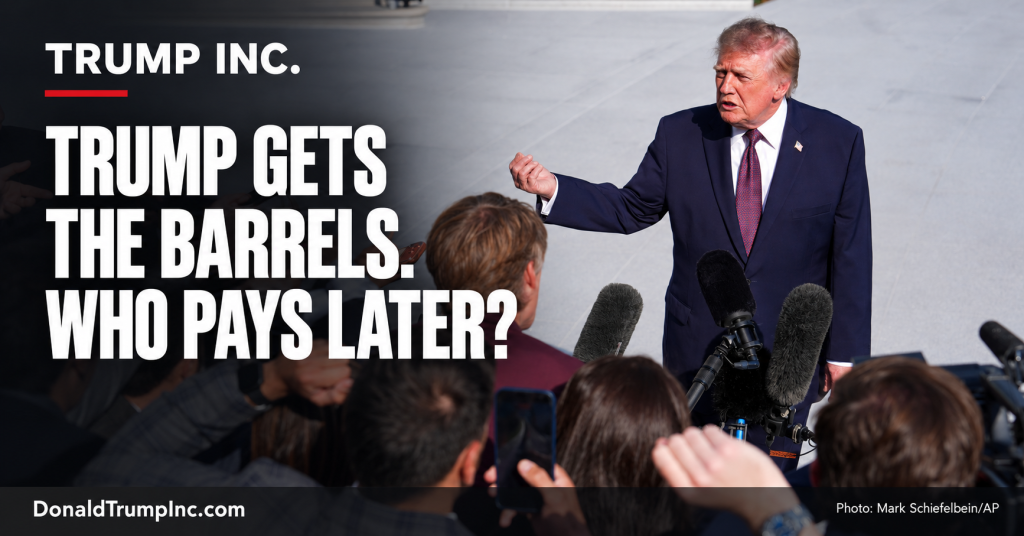
President Donald Trump speaks to reporters on the South Lawn of the White House on October 2, 2026. Photo: Mark Schiefelbein/AP. Cover typography and branding: Trump Inc.