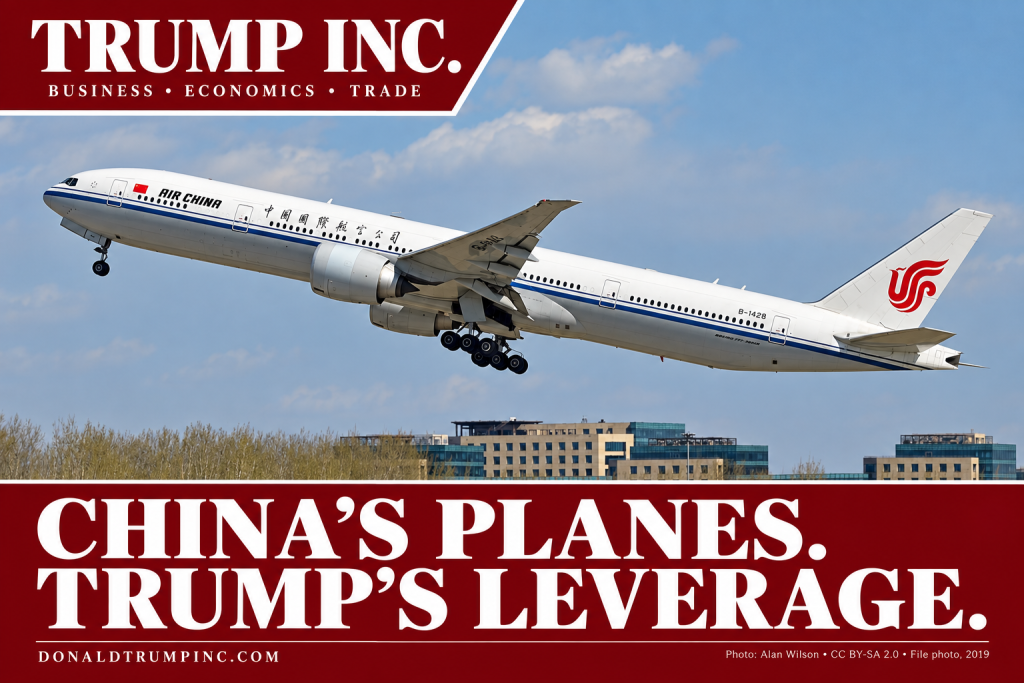
CHINA’S PLANES. TRUMP’S LEVERAGE.
Analysis | Aircraft parts, rare earths and the business value of keeping somebody else’s fleet running.
Air China Boeing 777-300ER B-1428 at Beijing Capital International Airport, March 22, 2019. Illustrative file photo; not a photograph of today’s licensing action. Photo: Alan Wilson / Wikimedia Commons, CC BY-SA 2.0. AI-assisted editorial graphic adapted from the photograph, with Trump Inc. branding and headline. Graphic adaptation licensed under CC BY-SA 2.0.
.jpg)
You can own the aircraft and still depend on somebody else to keep it flying.
That is the business question behind a new pressure point in U.S.–China trade talks: how much negotiating power comes from controlling access to essential supplies?
What Reuters reports
Reuters reported on October 1, citing people familiar with the matter, that the Commerce Department has slowed aircraft-parts export licensing to China. Officials are also considering rules that could make restrictions easier, including a draft licensing requirement for aviation hydraulic fluid. The effort comes as Washington seeks better access to Chinese rare earths.
The licensing slowdown is reported activity; the additional rules remain proposals. Reuters said the White House and Commerce Department had not immediately responded to requests for comment. The report does not establish a blanket parts ban or the grounding of China’s fleet.
The asset is continued operation
DT Inc.’s interpretation: an aircraft’s purchase price captures only part of its economic value. The buyer wants years of useful service. Anything that makes continued operation uncertain can change how that buyer values the original purchase—and the relationship with its suppliers.
Consider a hypothetical airline that owns an expensive jet but cannot confidently obtain an essential replacement component. The ownership certificate remains intact. The expected earnings from the aircraft become less certain.
That gap between owning an asset and being able to use it is where bargaining power can emerge. A supplier does not have to own the customer’s fleet to matter to its operating decisions.
The valuable asset may be the ability to keep somebody else’s aircraft operating.
Rare earths meet aircraft parts
The negotiating logic is reciprocal dependence: each side examines the supplies the other side needs and asks what access is worth.
A licensing delay can introduce uncertainty without becoming a permanent prohibition. In business terms, uncertainty itself can carry a cost. Buyers may consider larger inventories, alternative suppliers or stronger contractual assurances. Those are possible responses, not developments independently established by this article.
Washington’s opportunity would be to turn access into a concrete concession. Beijing’s incentive would be to reduce the exposure that makes such pressure possible. The duration of any advantage would depend partly on how difficult and costly substitution becomes.
American suppliers gain importance—and carry risk
A company can become more strategically valuable to its government while becoming less commercially attractive to a customer.
That is the tension here. If access to American components becomes a negotiating tool, suppliers could gain bargaining importance while risking sales, delivery confidence and future orders. A customer worried about political interruptions may look for ways to rely less on that supplier.
The tradeoff cannot be settled by calling the move tough or weak. A temporary constraint that secures valuable, durable access could have a different economic result from a prolonged dispute that loses customers without producing concessions.
Government negotiating power and supplier profitability are related questions. They are not automatically the same outcome.
What would count as a win?
Judge the result by what changes: clearer access to needed materials, predictable licensing, actual deliveries and the commercial cost borne by suppliers and customers.
A proposal is not an enacted rule. Pressure is not a signed concession. And a signed concession still needs performance before it becomes a business result.
The hook is CHINA’S PLANES. TRUMP’S LEVERAGE. The test is whether that leverage produces benefits worth the cost of using it.
DT Inc. take: Ownership tells you whose aircraft it is. Reliable access helps determine what that aircraft is worth.
Source and disclosure: News summary based on Reuters’ October 1, 2026 reporting by Karen Freifeld and Allison Lampert. Trump Inc. has not independently confirmed the sources’ accounts. The economic interpretation and hypothetical examples are DT Inc. analysis. AI-assisted article.